Search

Popular Posts

Saturday, October 10, 2009

A Look At Intelligent Evolution

A Look at Intelligent Evolution

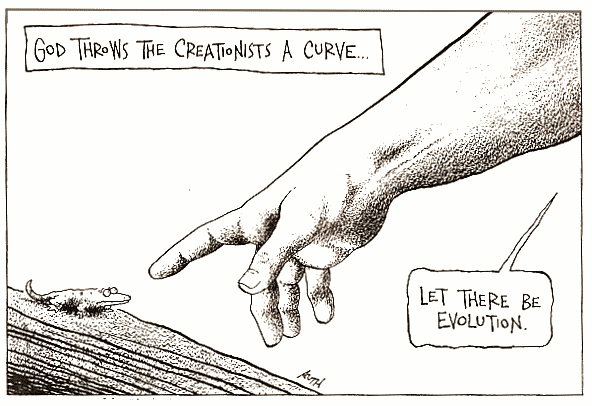
Can we believe in a Creator and evolution?

Arguing for God being the Creator of the universe doesn’t necessitate an attack on the theory of evolution. Don’t misunderstand me; some evolutionists (particularly some of the neo-atheists like Richard Dawkins, who argues in his new book people who don't believe in evolution are on the same level as Holocaust deniers) have gone ape over their theory (forgive the pun) to the point that they seem to forget it is a theory, and refer to it as if it is an undeniable scientific fact. (Please note: when I speak about evolution, I’m referring to Darwin’s macroevolutionary theory: life began millions of years ago from a kind of primordial ooze that gave rise to single-celled creatures, which then evolved into more complex ones, all the way up to we humans.)

Is the theory of evolution true? It definitely has its problems, but whether it is or isn’t true doesn’t impact the notion that God is the Creator of the world. Scientific theories about origins simply talk about how things came to be, not whether God was behind it. For Christians to argue about scientific theory—any theory—because they think it attacks the notion that God is the Creator seems silly.

What if the point of the creation narrative in Genesis was more poetic than literal? Historically, the Church has always held this position about creation. The Church’s take was simply that God created the world. That’s it. Before the nineteenth century, the Church never tried to specify how or when God did it. Those in the ancient world (to whom the text was written) did not think in literal or scientific terms, nor would they have cared about such notions. The big news of Genesis to the ancient world was that ONE God, not many, was responsible for all we see. That radical, salient point rang through that world which believed in many gods—not one—and had absolutely nothing to do with science.

A belief in God does not necessitate that a person accept the position that the earth is just six thousand years old. The historical, theistic argument is simply that we believe God is the why behind what is here, whenever and however it got here. Scientists may ultimately tell us how and when everything happened in ways not articulated in the biblical text, but science will never be able to tell us why. Why is the stuff of belief. Understanding this helps us be open to the research and questioning of science, while recognizing such questioning is not an enemy to faith.

Science does not have to be an enemy of faith. Nanoscientist James Tour, a professor at Rice University, spends his life building molecules in the lab. He says, “I stand in awe of God because of what he has done through his creation. Only a rookie who knows nothing about science would say science takes away from faith. If you really study science, it will bring you closer to God.”

One could say that the order of non-living things—the laws that govern physical objects, the earth orbiting the sun, the seasons coming and going, the laws governing atoms and the subatomic universe—is enough evidence to assert that there is a God who designed things to be the way they are. But the most compelling evidence—the evidence that seems to scream: THERE IS A GOD! — comes from things that are alive.

Dr. Walter L. Bradly, an expert on polymers and thermodynamics, says, “Ice crystals have a certain amount of order, but it’s simple, repetitive, and has a low amount of information, sort of like filling a book with the words, ‘I love you, I love you, I love you’ over and over again. In contrast, the kind of complexity we see in living matter has a high information content that specifies how to assemble amino acids in the right sequence, like a book being filled with meaningful sentences that communicate a story. Unquestionably, energy can create patterns of simple order. For instance, you could see ripples on the sand at a beach and know they were created by the action of waves. But if you saw the words, ‘John loves Mary’ and a heart with an arrow drawn in the sand, you know that energy alone didn’t create that.”

Even the smallest, single-celled organisms have more complexity within their cellular walls then anything scientists have been able to recreate using huge supercomputers. What guides the process in all living things is DNA, which regulates every cell of every plant and animal. The DNA molecule is like a tiny microprocessor that controls everything a living cell does. The data encoded on the DNA inside every cell of every living thing is a kind of written language. The English language uses a twenty-six-letter alphabet; DNA uses a four-letter chemical alphabet. As the chemicals are arranged in various “lettered” sequences, they form what amounts to words, sentences, and paragraphs containing all the instructions needed to guide a living cell. The DNA molecule instructs cells on how to make proteins, what and how to eat, how to get rid of waste, when to divide, how to repair itself, and so on. So, where did DNA come from? How was the code “written?” Was it written by chance or was there a Designer?

British chemist Leslie Orgel once said, “Evolution is smarter than you are,” to which atheist Christopher Hitchens responded, “But this complement to the ‘intelligence’ of natural selection is not by any means a concession to the stupid notion of ‘intelligent design.’”

Why not? Why couldn’t evolution have an intelligence that was put in it by God? That Hitchens (along with the other neo-atheists) can make no “concession” to the possibility of God being involved is evidence of a silly prejudice. It is not a logical observation.

Ed Gungor is a pastor and author. He can be found at SaltTribe.org.


Thursday, October 8, 2009

Liquid Neglect

From the Sept 12th, 2009 edition of the New York Times.

From the "Toxic Waters" series.

Jennifer Hall-Massey knows not to drink the tap water in her home near Charleston, W.Va.

In fact, her entire family tries to avoid any contact with the water. Her youngest son has scabs on his arms, legs and chest where the bathwater — polluted with lead, nickel and other heavy metals — caused painful rashes. Many of his brother’s teeth were capped to replace enamel that was eaten away.

Neighbors apply special lotions after showering because their skin burns. Tests show that their tap water contains arsenic, barium, lead, manganese and other chemicals at concentrations federal regulators say could contribute to cancer and damage the kidneys and nervous system.

“How can we get digital cable and Internet in our homes, but not clean water?” said Mrs. Hall-Massey, a senior accountant at one of the state’s largest banks.

She and her husband, Charles, do not live in some remote corner of Appalachia. Charleston, the state capital, is less than 17 miles from her home.

“How is this still happening today?” she asked.

Click here to read more on how "Clean Water Laws Are Neglected, At A Cost In Suffering" by Charles Duhigg

Wednesday, October 7, 2009

The Burger That Shattered Her Life

From the October 4th edition of the New York Times.

Craig Wilson, Costco’s food safety director, said the company decided it could not rely on its suppliers alone. “It’s incumbent upon us,” he said. “If you say, ‘Craig, this is what we’ve done,’ I should be able to go, ‘Cool, I believe you.’ But I’m going to check.”

Costco said it had found E. coli in foreign and domestic beef trimmings and pressured suppliers to fix the problem. But even Costco, with its huge buying power, said it had met resistance from some big slaughterhouses. “Tyson will not supply us,” Mr. Wilson said. “They don’t want us to test.”

A Tyson spokesman, Gary Mickelson, would not respond to Costco’s accusation, but said, “We do not and cannot” prohibit grinders from testing ingredients. He added that since Tyson tests samples of its trimmings, “we don’t believe secondary testing by grinders is a necessity.”

The food safety officer at American Foodservice, which grinds 365 million pounds of hamburger a year, said it stopped testing trimmings a decade ago because of resistance from slaughterhouses. “They would not sell to us,” said Timothy P. Biela, the officer. “If I test and it’s positive, I put them in a regulatory situation. One, I have to tell the government, and two, the government will trace it back to them. So we don’t do that.”

Click here to read the article detailing the sad fate of young Stephanie Smith of Minnesota, stricken with E. Coli from a contaminated hamburger that slipped through the shoddy safety net of the beef industry.

Tuesday, October 6, 2009

If There Is Consciousness, There Is A Soul


From The Bhaktivedanta Center blog from The University of Virginia:

by Mayapriya Dasi

Americans love their pets. We feed them better than most humans in third world countries are fed. We dote on them with toys at Christmas, and we award them the honorary status of “children.” But do we acknowledge that all creatures are, like us, spirit soul? Do we honor them as living entities working their way slowly toward perfection, or do we just cater to their bodies—treating them like they are toys for our amusement?

The spiritual literatures studied by Bhakti yogis teach that every living entity is, at it’s fundamental core, a spirit soul (called the atma). Every living being is a soul—individual and equal—wearing an individual body. In other words, the soul that is presently in your puppy, Fredo, is an individual living entity spending that lifetime inside the body of a dog. But look deep in Fredo’s eyes and you might sense the atma looking back at you.

Try this. Think of bodies as light bulbs. Some are 15 watt, some 30 watt, some 1000 watt. The electric current that runs through the walls, into the lamp and to the bulb is the same. What is different is each bulbs capacity to express the current. A 15 watt bulb can only funnel just so much current into usable light. A 1000 watt bulb can channel so much more.

Dungbeetle

So, in the same way, different bodies are capable of expressing different amounts of consciousness. A dung beetle is concerned only with rolling or burrowing deeper into the cow patty. A dog body can express happiness, anger and love. A human birth allows the greatest expression of consciousness. But even within the human birth, there are gradations of consciousness.

On the one hand, we treat our pets like they were little humans. But if asked, is an animal a spirit soul, most Westerners raised in a Judeo-Christian paradigm will say “No, only humans have souls.” Yet, the symptom of the soul is consciousness. Even slight consciousness attests to the occupation of the body by the soul (atma). If Fredo stops breathing, you may say your dog “died.” I use quotes because in Bhagavad-gita we learn,

“That which pervades the entire body you should know to be indestructible. No one is able to destroy the imperishable soul.” —BG 2.17

You might say, “Fredo’s gone!” Never the less, the body looks the same (just like Fredo is sleeping). What’s gone? The answer is: the atma (soul). And as a result, there is no more consciousness illuminating the body (like the electricity in the bulb). The atma has left Fredo’s body and is on it’s way to a new body.

“As the embodied soul continuously passes, in this body, from childhood to youth to old age, the soul similarly passes into another body at death. A sober person is not bewildered by such a change.” —BG 2.13

“Bodies are material productions of different modes of material nature, but the soul and Supersoul within the body are of the same spiritual quality.”
—Purport BG. 2.18 by A.C. Bhaktivedanta Swami


When you watch this Youtube video about Tara and Bella, remember that at one time in this country (not so very long ago), women and African Americans were considered property with no rights, and often treated inhumanely. Today, animals and other conscious beings, because they are not humans, suffer horrific cruelties (even with pets we often decide what’s “good” for them based on what’s convenient for us). We thoughtlessly squash a spider or ant. Some hunt animals to kill for “sport.”

Yet Tara and Bella show us that we should reconsider our “dominion” over other species. Does dominion over atmas who are perhaps akin to a lower wattage bulb (in the example above) mean we have the right to kill them at will? Or does dominion mean to care for and protect all living beings? We should develop equal vision. Seeing all living beings as spirit soul, fundamentally and qualitatively equal, though presently expressing their consciousness through a vast variety of bodies, large and small, with simple or complex consciousness.

Tara and Bella

Tara and Bella

Tara and Bella understand that their vastly different bodies should not be an impediment to friendship. Perhaps we could learn something from them.

Sunday, October 4, 2009

The Age of Eco-Angst

From the Sept 27th "Good Times: The Pursuit Of What Matters In Troubled Times" opinion section of The New York Times

by Daniel Goleman

My grandson’s third birthday is at hand, and I’m looking at a toy racing car I won’t be giving him. Painted a bright yellow, this nifty little toy seemed just right for him when I paid a buck for it at a big box store. But before I could give it to him, I learned that cheap toys made in China, like this one, can have lead in their paint — particularly reds and yellows — to make them more shiny.

My pleasure at picturing his delight at the toy car melted into something between disgust and outrage. That nifty toy sits on my desk months after I bought it.

Call it eco-angst, the moment a new bit of unpleasant ecological information about some product or other plunges us into a moment (or more) of despair at the planet’s condition and the fragility of our place on it.

Eco-angst, it turns out, is but one version of a widely studied psychological phenomenon, one well-known in the world of retailing. Take a bargain bin cabernet, tell people it’s an expensive, estate-bottled varietal, and they’ll tell you they like it. They’ll even linger longer over their dinner, enjoying not just the wine but the rest of their food more. Now describe the same wine as a low-end variety from North Dakota, and they’ll tell you it’s not so good — and finish their meal faster, enjoying it less.

We will no longer be impressed by an organic T-shirt if its cotton was grown by hogging water in an arid and impoverished land, or if its dye puts workers at heightened risk for leukemia.

The difference lies, of course, in the perception, not the reality. The emotional power of this perceptual skew has been documented in experiments not just with wines, but even pain relievers — the more expensive ones always seem better. Mindset drives our experience of a product, a fact known intuitively by advertisers long before the era of “Mad Men.” Back in the 1920s, Edward Bernays, a nephew of Sigmund Freud, became an influential pioneer of public relations by capitalizing on the power of psychological manipulation of the public to sell products. Advertising and psychology has been intertwined ever since.

What’s more, brain imaging now reveals that tasting what we think is a high-end wine produces heightened activity in a key strip of neurons in the orbitofrontal cortex, which lights up during moments of keen interest — a pattern some neuroeconomists see as the brain signature for brand preference. The “low-end” wine, on the other hand elicits not a budge in orbitofrontal chatter, a pattern indicating disinterest or disgust. (Study data can b found here.)

The neural signature for disgust may soon become more prevalent in the aisles of stores with the advent of heightened transparency about the ecological impacts of retail products like deodorants, foods and toys. A new generation of information systems has begun to offer detailed evaluations of once-hidden ecological impacts for tens of thousands of items, and the picture is not always pretty.

Eco-angst dawns with the discovery that some children’s sunblock contains a chemical that becomes a carcinogen when exposed to the sun, or that the company that makes a popular organic yogurt operates in ways that result in significantly more greenhouse gases than their competitors. The moral here, or course, is not to stop using sunblock nor to give up yogurt, but to choose the brands without these downsides.

Such distasteful information has predictable consequences for marketing, particularly if the eye-opening data comes at the moment we’re comparing two brands. Psychologists call it the “contrast effect”: as Item A suddenly looks bad, we get an even stronger preference for Item B. It is also a marketing boon for products that do no harm.

Eco-angst among consumers may soon spread as information about products is increasing easy to get. GoodGuide.com, is a Web site (with its own iPhone application) that instantly compares any of 75,000 consumer products on their environmental, health, and social impacts. Another Web site, SkinDeep.com, analyzes every ingredient in personal care products to match them with findings from medical databases; it ranks, for example, more than a thousand shampoos on their likely levels of toxicity.

The blockbuster for ecological transparency was the announcement in July by Wal-Mart that they are developing a similar sustainability index with the help of an academic consortium. One day shoppers, it seems, will get ecological ratings of products along with price in Wal-Mart (and likely other major retailers as well) as they stroll the aisles.

These rating systems herald the death of “greenwashing,” the advertising sleight-of-hand that plucks a single virtue from a multitude of a product’s ecological impacts and touts its environmental goodness. We will no longer be impressed by an organic T-shirt if its cotton was grown by hogging water in an arid and impoverished land, or if its dye puts workers at heightened risk for leukemia, or if it was stitched together in a sweatshop where young women suffer from needless injuries.

Industrial ecology, the fledgling discipline that renders precise analyzes of the multitude of ecological impacts any manmade item has over its life cycle, tells us that there is little or nothing manufactured today that nature loves. Ours is an age of eco-angst because virtually all our industrial platforms, processes and chemicals were developed in a day when people were oblivious to their ecological impacts.

It’s not that no one cared — no one really knew. Industrial ecology has only come of age in the last decade or two, and has yet to make its findings widely known. But as ecological transparency comes to the aisles of stores near you and me, it opens an opportunity for us to vote with our dollars with unprecedented precision for better ecological impacts.

Rather than taking the ascetic route of “No Impact Man,” we can together become high impact shoppers, tipping market share to products with gentler ecological imprints. But to do so we need to face the often unattractive truths behind the making of our favorite stuff, and so risk a stiff dose of disgust.


Daniel Goleman
Daniel Goleman reported on the brain and behavioral sciences for The New York Times for 12 years. He is the author of several books, including his most recent, “Ecological Intelligence: How Knowing the Hidden Impacts of What We Buy Can Change Everything.” His Web site is www.DanielGoleman.info.

Saturday, October 3, 2009

Left Behind as Progress Marches On

It is a question of Old India vs New India, of a burgeoning superpower desperate to feel of importance in a world ready to embrace its immense manpower and resources.

What gets lost in the shuffle is the traditional way of life, the real culture of our mother, which is an observation all astute observers, like Prabhupada no less, has making for decades and decades.

What is the human cost, the cultural cost, when the agricultural foundation of such a country is deemed as not being most beneficial to the bottom line.

You can read more about this in the article "Drought Puts Focus On Side Of India Left Out Of Progress" from the Sept 4, 2009 edition of the New York Times.

Thursday, October 1, 2009

The Skull That Rewrites The History Of Man

From The Vedic Observer
"Evolution: Science or Skullduggery" by Kundali Dasa

"According to William Fix, author of The Bone Peddlers: Selling Evolution, awe and reverence is exactly what the evolution scientists intend us to feel. Fix claims that while making a careful analysis of the more than one hundred and twenty years of archeological discoveries, he unearthed a "catalogue of fiascos,” findings recorded by researchers more interested in publicity, funding, and reputation than in truth. To protect their pet theories and their reputations, says Fix, researchers have deliberately ignored or dismissed contrary evidence. To back his claim he cites examples—one of them the discovery of a "
modern-type" skull some seven hundred thousand years old. Fix ultimately concludes, "The origin of man is more mysterious than either the evolutionists or creationists contend."

For more of the mystery and intrigue, click here to read a recent article from The Independent on a "skull that rewrites the history of man."